Tuesday, November 28, 2006

Selected resources on the history of The Morton Arboretum

A frequent question that we receive in the Sterling Morton Library is about the history of The Morton Arboretum. In the Library, we've purposefully gathered a number of resources detailing the Arboretum's history. In addition to our institutional archives containing letters, photographs and other documents, I've listed some selected resources highlighting the foundation, development and growth of the Arboretum:

  • Ballowe, James. A great outdoor museum : the story of The Morton Arboretum, 2003. [REF QK73.M6 B3]
  • Doty, Carol. The Arboretum’s architectural heritage: Part I in The Morton Arboretum Quarterly, v. 26, no. 4 (Winter 1990), p. 49-59.
  • Doty, Carol. The Arboretum’s architectural heritage: Part II in The Morton Arboretum Quarterly, v. 27, no. 1 (Spring 1991), p. 1-9.
  • Doty, Carol. The Arboretum’s architectural heritage: Part III in The Morton Arboretum Quarterly, v. 27, no. 4 (Winter 1991), p. 58-64.
  • Larkin, Joseph. The developing landscape: The Morton Arboretum comes of age, Anthony Tyznik, 1953-1993 in The Morton Arboretum Quarterly, v. 31, no. 3 (Autumn 1995), p. 39-43.
  • Mehaffey, Scott. Laying the foundation : landscape architecture at The Morton Arboretum, O.C. Simonds and Clarence Godshalk, 1922-1953 in The Morton Arboretum Quarterly, v. 31, no. 3 (Autumn 1995), p. 33-38.
  • Planning the arboretum in The Morton Arboretum Quarterly, v. 1, no. 3 (Autumn 1965), p. 10-12.
  • Schulenberg, Ray. The Arboretum landscape – a sesquicentennial perspective in The Morton Arboretum Quarterly, v. 4, no. 4 (Winter 1968), p. 49-61.
  • Simonds, O.C. The Morton Arboretum in 1925: some of the landscape features in The Morton Arboretum Quarterly, v. 26, no. 4 (Winter 1990), p. 60-64.


The next time you're visiting the Arboretum, stop by the Sterling Morton Library and learn more about our remarkable history. Not able to visit us in the near future? Please email me and I will be happy to assist you in pursuit of all things historical!

Wednesday, November 22, 2006

Thanksgiving holiday hours in the Sterling Morton Library – 2006

Wednesday, November 22 - open - 9 a.m. – 5 p.m.
Thursday and Friday, November 23-24 – closed
Saturday, November 25 - open - 10 a.m. – 4 p.m.
Sunday and Monday, November 26-27 – closed

The grounds of The Morton Arboretum will be open during this time from 7 a.m. – 5 p.m. The Visitor Center will be closed on Thanksgiving Day.
Visit the Arboretum's general information page for more details about the Arboretum’s open hours.


Happy Thanksgiving!

Thursday, November 16, 2006

Plant Societies and Associations, or, the company you keep!

I was just corresponding with someone from the International Oak Society and I started musing about the concept of plant societies. Plant societies and associations come is all shapes and sizes. Some of these groups focus on specific plants such as oaks, maples or hostas and other groups are interested in related plants such as conifers or perennials. Still other societies are interested in plants from certain habitats like alpines, aquatics or native plants and, then, there are the societies that focus on gardening in a specific geographic region. The Sterling Morton Library is a member and receives publications from a number of different plant societies and associations. Beyond their fascinating newsletters and journals, these special interest groups host tours, exchange plants or seeds, present conferences and offer other educational activities to encourage and share their knowledge and passion for plants. What a terrific learning opportunity! Are you passionate about a certain plant or group of plants? Consider stopping by the Sterling Morton Library to explore our collection of plant society publications. For further information about selected plant societies, visit:

For a more extensive list, look at the recently updated Guide to Plant Societies and Associations from the Iowa State University Extension.

Tuesday, November 14, 2006

Articles of note in the Sterling Morton Library : November's offerings

These are some recent articles that can be found within the journal collection of the Sterling Morton Library. Please visit the Library to discover the incredible botanical and horticultural resources that await you! If you are unable to visit the Library and interested in reviewing one of these articles, I would be delighted to help you at rhassert@mortonarb.org.

Doughty, J. Flower pounding. Nature Printing Society Newsletter, v. 29, no. 4, p. 1-3.

Hind, N. Description of Ratibida columnifera var. Pulcherrima. Curtis’s Botanical Magazine, v. 23, pt. 4, p. 267-277.

Leendertz, L. Tastes of the unexpected [unusual and unfamiliar fruit]. The Garden, v. 131. no. 11, p. 746-749.

Niinemets, U. and F. Valladares. Tolerance to shade, drought, and waterlogging of temperate Northern Hemisphere trees and shrubs. Ecological Monographs, v. 76, no. 4, p. 521-547.

Nunn, A. J. and others. Testing the unifying theory of ozone sensitivity with mature trees of Fagus sylvatica and Picea abies. Tree Physiology, v. 26, no. 11, p. 1391-1403.

Raupp, M. J. and others. Street tree diversity in eastern North America and its potential for tree loss to exotic borers. Arboriculture & Urban Forestry, v. 32, no. 6, p. 297-304.

Sewell, M and M.A. Vincent. Biosystematics of the Phacelia ranunculacea complex (Hydrophyllaceae). Castanea, v. 71, no. 3, p. 192-209.

Starman, T. and L. Lombardini. Growth, gas exchange, and chlorophyll fluorescence of four ornamental herbaceous perennials during water deficit conditions. Journal of the American Society for Horticultural Science, v. 131, no. 4, p. 469-475.

Wells, C. and others. Effects of planting depth on landscape tree survival and girdling root formation. Arboriculture & Urban Forestry, v. 32, no. 6, p. 305-311.


Friday, November 10, 2006

They're back!

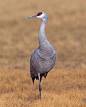
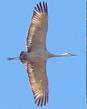
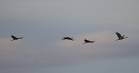
What a treat! As I sauntered out for yesterday’s walk, I suddenly heard the dulcet sounds of the Sandhill cranes. As it turned out, I actually did very little walking and mostly stood watching as wave after wave of these birds flew overhead. Most of the flocks were quite high up, but they were clearly visible in the sky as they wheeled and turned like swirling leaves. What a treat it is to be at the Arboretum to witness the spring and fall migration of these birds!
We’re fortunate in this area to be so close to
Jasper-Pulaski Fish and Wildlife Area in Indiana. (Great recent article in Chicago Wilderness Magazine about Jasper-Pulaski.) The cranes often stop at J-P to refuel and there are several viewing areas to watch (and listen) to these birds. According to their recent migration report, on November 6th @ 14,436 cranes were counted at J-P. Whew! That’s a lot of cranes!
If I piqued your interest in these birds, I would encourage you to visit the Sterling Morton Library and explore these resources:

Crane music : a natural history of American cranes by Paul A. Johnsgard - QL696.G8J59
The cry of the sandhill crane by Steve Grooms - QL696.G84G76

Sandhill Crane (Grus canadensis) in The Birds of North America, No. 31 - Reference QL681.B62 – terrific resource with lots of detailed information
Sandhill cranes by Lynn Stone - J QL696.G84 S76

The sandhill cranes by Lawrence Walkinshaw - QL696.G8W3
In addition to these books, our journal collection contains such titles as Audubon, Bird Watcher's Digest, Living Bird, Illinois Audubon and National Wildlife which would also have articles of interest.
While our collections in the Sterling Morton Library focus on works of botany and horticulture, we have a rich collection of birding resources.
Further information can also be found at:
Cornell Lab of Ornithology
International Crane Foundation
Illinois Natural History Survey
Wikipedia

Hope you have an opportunity to witness this seasonal avian event!


Tuesday, November 07, 2006

Espalier : not for the faint of heart!

As much as I’m a fan of autumn with its attendant colorful sights, sounds and scents, I actually relish this time of the year when the leaves have almost all dropped! Walking around the Arboretum on any given day presents a terrific opportunity to truly see the trees with their unique forms, shapes and structures. As aspiring horticulturists know, it is one thing to read about a tree that is described as vase-shaped or pyramidal and quite another to view this tree up close and in person. This time of the year lets me study the trees without the leafy distractions!

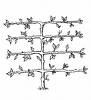
In addition to a tree’s natural form, the Arboretum has several examples of espaliered trees. Espalier as defined by The American Horticultural Society Encyclopedia of Gardening is “a plant trained with the main stem vertical and (usually) three or more tiers of branches horizontally placed on either side in a single plane; often applied to fruit trees.” Two shining examples of espaliered trees at the Arboretum can be found in the May T. Watts Reading Garden adjacent to the
Sterling Morton Library. These remarkable trees planted in 1963, trained to grow on the Library walls are the dawn redwood (Metasequoia glyptostroboides) and ginkgo (Ginkgo biloba). Both of these trees were selected for the garden because of their fascinating horticultural and botanical history. When you visit this special garden, you'll see that they've done remarkably well over the past 43 years in a fairly narrow space. Our horticulturists work their magic at nurturing and maintaining these plants. Another example of this training/pruning technique can be found near the temporary entrance to the Library/Administration Building. As you walk from the parking lot toward the temporary entrance, you'll see a fairly young espaliered Prairifire crabapple growing on the Library exterior wall.

Consider using this interesting technique in your own landscape!

For additional information, please see these resources in the Sterling Morton Library:


Peruse the Library’s catalog searching under the subject heading of pruning. Information on this technique typically can be found within resources on pruning and training of trees and shrubs.

Also look at these monographs on the topic:
Espalier fruit trees : their history and culture by Alan Edmunds - SB359.5 .E34 1986
Special cases : pruning for particular purposes by Karan Davis Cutler in Pruning trees, shrubs & vines - SB125 .C76

Journal articles of interest:
Patterned artistry by Craig Bergmann in Chicagoland Gardening, v. 12, issue 2, p. 70-73.
Tight spot training by Jason Upright in Garden Design, issue 136, p. 100.
An espalier for every garden by Peter Thevenot in Fine Gardening, issue 70, p54-59.
As the twig is bent : training trees into espaliers turns blank walls into living tapestries by Jack Ruttle in Garden Design, v. 16, issue 3, p. 78-85.
The elegant espalier by Lee Reich in Horticulture, v. 74, issue 2, p. 38-42.

Websites of interest:
Starting an espalier from the Victory Garden
Wikipedia article
Step by step guide from the BBC

Friday, November 03, 2006

Sculpture in the Sterling Morton Library

Created by noted sculptor Sylvia Shaw Judson, the Rain Tree Fountain is on display in the Sterling Morton Library. A memorial to two of Joy Morton's granddaughters, this bronze-cast fountain once flowed on the grounds of The Morton Arboretum at Thornhill where the Four Seasons Garden is currently located. Born and raised in Lake Forest, Judson was the daughter of noted Chicago architect Howard Van Doren Shaw. Other significant and familiar commissions by Judson include the large acorns found in Arbor Court that once marked the Arboretum’s entrance gates and the Bird Girl used on the cover of the book Midnight in the Garden of Good and Evil.


In addition to this sculpture, the Library has the following resources on the work of Sylvia Shaw Judson:

  • The "Bird girl" : the story of a sculpture by Sylvia Shaw Judson
  • For gardens and other places : the sculpture of Sylvia Shaw Judson
  • A brief article in The Morton Arboretum Quarterly, v. 6, no. 2, p. 26-27 (Summer 1970).

Stop by the Library to view this spirited work by an Illinois artist!

The Sterling Morton Library is open Tuesday-Friday from 9-5 and Saturday from 10-4.