Thursday, June 29, 2006

Articles of note in the Sterling Morton Library : June's offerings

These are some recent articles that can be found within the journal collection of the Sterling Morton Library. Please visit the Library to discover the incredible botanical and horticultural resources that await you! If you are unable to visit the Library and interested in reviewing one of these articles, I would be delighted to help you at rhassert@mortonarb.org.

Becker, Jim. For luck with lavenders. Horticulture, v. 103, no. 5, p. 26-29.

Becker, Jim. The right lavender for your region. Horticulture, v. 103, no. 5, p. 30-31.

Childs, Jim. Butterfly magnets : Garden Gate’s top 10 picks. Garden Gate, no. 70, p. 16-21.

Ferrini, F. and M. Baietto. Response to fertilization of different tree species in the urban environment. Arboriculture & Urban Forestry, v. 32, no. 3, p.93-99.

Flint, Harrison. Alternatives to ash. American Nurseryman, issue 12, v. 203, June 15, 2006, p. 14-20.

Grant, Peter R. and B. Rosemary Grant. Species before speciation is complete. Annals of the Missouri Botanical Garden, v. 93, no. 1, p. 94-102.

Hynes, Erin. Everything on a stick. Northern Gardener, v. 134, no. 4, p. 34-37.

Jackson, Bernard L. Butterflies in the rock garden. Rock Garden Quarterly, v. 64, no. 2, p. 115-118.

Jewell, David. When less is more: see-through perennials. The Garden, v. 131, pt. 6, p. 422-425.

Peltier, Patrice. The buzz on bee balm. Chicagoland Gardening, v.12, no. 4, p. 50-55.

Rogers, Ray. Beguiling begonias. Garden Design, no. 139, p. 24-28.

Watson, Gary. The effect of paclobutrazol treatment on starch content, mycorrhizal colonization, and fine root density of white oaks (Quercus alba L.) Arboriculture & Urban Forestry, v. 32, no. 3, p. 114-117.

Watson, Gary and Angela Hewitt. Getting the roots right. American Nurseryman, issue 12, v. 203, June 15, 2006, p.35-39.

Why do public gardens matter? Special topical issue of the Public Garden, v. 21, no. 1.

Saturday, June 17, 2006

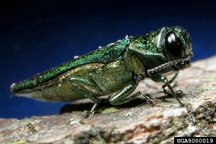
Emerald ash borer (EAB)

All Illinois tree admirers gave a collective shudder with the announcement of the discovery of the nefarious emerald ash borer within our state. The Illinois Department of Agriculture (IDOA) made the June 13th announcement indicating the beetle had been found in a yard of a Kane County home east of Lily Lake. This insect, originally from Asia, has become a significant ecological concern to our region. First detected in June 2002 in the Detroit area, arborists and scientists have since been tracking the appearances of this insect. As noted by the IDOA announcement “The emerald ash borer is a small, metallic-green beetle native to Asia. Its larvae burrow into the bark of ash trees, causing the trees to starve and eventually die. While the beetle does not pose any direct risk to public health, it does threaten the tree population. Since the emerald ash borer was first confirmed in the Midwest in the summer of 2002, more than 20 million ash trees are dead or dying.” Curiously, in the insects’ native range of Asia, it attacks and kills trees that have already been stressed and weakened while in North America, this insect attacks healthy trees. Considering that an estimated 20% of street trees in the Chicago area are ash, the significance of this insect announcement and outbreak is great!
Further reading --

If you are making some plant selection decisions, you may wish to review the article Alternative to Ash (Is emerald ash borer affecting your ash trees? A Purdue University horticulture professor emeritus offers a list of 13 trees that could be used as substitutes for Fraxinus in the landscape.) by Harrison Flint in the June 15, 2006 issue of American Nurseryman.

For a global view of species invasions, read Yvonne Baskin's
A plague of rats and rubbervines : the growing threat of species invasions, 2002. In this work, Baskin explores the environmental toll and consequences of our shrinking, mobile world.

Rare Book School

I’ve just returned from a week immersed in a world where words like verso, signatures, integral and incunabula are bandied about with extreme precision. The University of Virginia campus in Charlottesville is the home of the Rare Book School (RBS). An independent non-profit educational institute supporting the study of the history of books and printing and related subjects, this school was founded in 1983 and moved to its present home at UVa in 1992. For me, it was a wonderful and academically rigorous week spent studying rare book cataloging. In addition to the scheduled classes, RBS offered a week filled with lectures, programs and outings to enhance the students’ knowledge of all things bookish.
Reasons for my interest in this class? The Sterling Morton Library has a significant collection of books including many published during the hand-press period prior to 1830. Herbals and works by Repton and Linnaeus are some examples of early works in our collection. Since these special collections books often have unique physical attributes, their cataloging records require special analysis, descriptors and headings to fully describe a work and enhance access. The immersive aspect of this week was also of particular interest to me. Being a student within the RBS community allowed me to intently study this area of interest and meet with scholars/students/instructors of note. The hoped for benefit from this class is the creation of a body of cataloging records that fully describe our wonderful collection and encourage/enhance/allow access to these resources by all!

Saturday, June 03, 2006

Articles of note in the Sterling Morton Library : May's offerings

These are some recent articles that can be found within the journal collection of the Sterling Morton Library. Please visit the Library to discover the incredible botanical and horticultural resources that await you! If you are unable to visit the Library and interested in reviewing one of these articles, we would be delighted to help you at library@mortonarb.org.

Carpenter, Amanda, et al. Developing a code of ethics for ecological restorationists. Ecological Restoration, v. 24, no. 2, p105-108.

De la Fleur, Marcus. Incorporating sustainable water principles into the design of the whole garden : combining the functional with the educational. Public Garden, v. 20, no. 4, p. 10-11.

Dickinson, Whitney, et al. The ethical challenges faced by ecological restorationists. Ecological Restoration, v. 24, no. 2, p. 102-104.

Engler, Kim. IPM [integrated pest management] in the landscape. American Nurseryman, v. 203, no. 10, p. 32-34.

Forrest, Todd. Botanic evolution : building on Marian Cruger Coffin’s original design, landscape architects help develop a living collection in a historic landscape [New York Botanical Garden]. Landscape Architecture, v. 96-no. 6, p. 34-44.

Louv, Richard. The nature-child reunion. National Wildlife, v. 44, no. 4, p. 22-30.

Macunovich, Janet. Charting a path : this simple approach yields a design that pleases the feet and delights the eye. Fine Gardening, np. 110, p. 40-43.

Mansson, L. An analysis of the analysis of herbivore population dynamics. Oikos, v. 113, no. , p. 217-225.

Niklas, Karl J. Allometric theory and the mechanical stability of large trees: proof and conjecture. American Journal of Botany, v. 93, no. 6, p. 824-828.

Stan, Amanda B. Dynamics of a managed oak woodland in northeastern Illinois. Natural Areas Journal, v. 26, no. 2, p. 187-197.

Wilson, Philip J. Axillary shoot growth, rooting and overwinter survival in stem cuttings of Viburnum dentatum ‘Chicago Luster.’ Journal of Environmental Horticulture, v. 24, no. 1, p. 6-12.